

What it solves
Traditional candidate search has two built-in limits:- One database. The right people are scattered across professional networks, code communities, research platforms, and company sites. A single database is bound to miss some.
- One pass. A single keyword match tends to return people with good-looking résumés, not people who are actually a good fit.
How it works
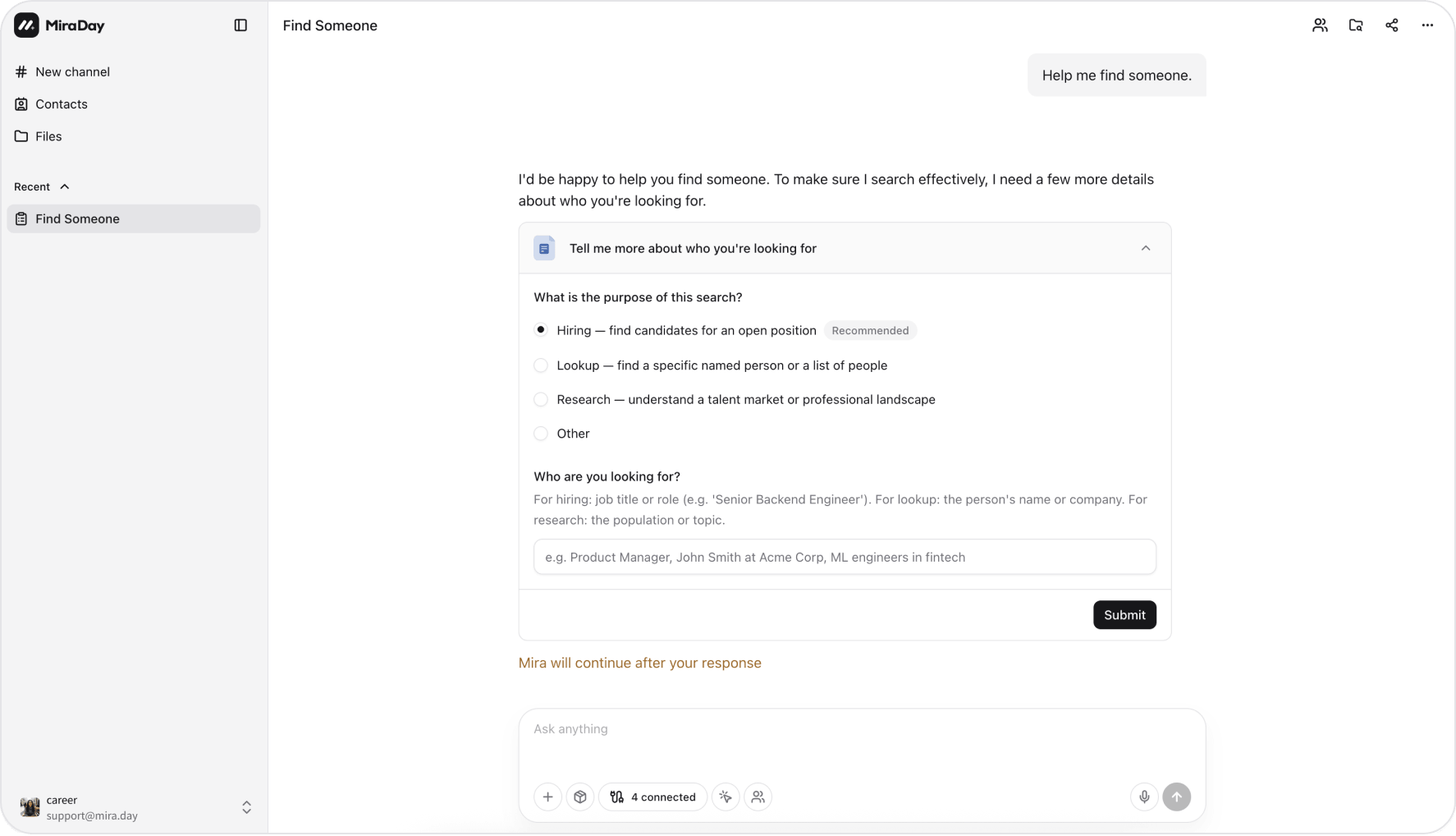
- You describe the need, in everyday language: the role, the must-haves, and the nice-to-haves.
- A Sourcing Agent searches across many talent sources and the open web, following signals (companies, tech stacks, projects, public work) and cross-checking them.
- You get explainable results: a candidate pool where every person comes with the reason they match.
- You refine. If the direction is off, just say so or add a constraint, and Mira adjusts.
Core capabilities
- Multi-source, multi-step: matching records from public sources are merged and deduplicated, and each hop is cross-checked. Private contact records remain separate from public candidates, even when they refer to the same person. Powered by MRE.
- Evidence-weighed matching: Mira evaluates each candidate against your must-haves and dealbreakers and ranks them by the evidence, surfacing the non-obvious (like the strong engineer who never updated their job title). Every candidate carries the reason behind the match.
- On-demand contact: once the right people are found, reveal email or phone as needed (each reveal uses credits).
Describe the role well
Mira understands natural language, but more context gives it more to reason about. A weak prompt and a strong one return very different candidate pools:
You can also lean on the implicit criteria you’d say out loud. Mira reasons about what they mean rather than matching them as keywords:
What’s next
- Must-haves & Dealbreakers: how Mira reads your requirements and builds the Ideal Candidate Profile.
- How MiraDay Matches Candidates: how MRE reasons to surface the right candidates.
- Agent Team: put a team on a complex search.